
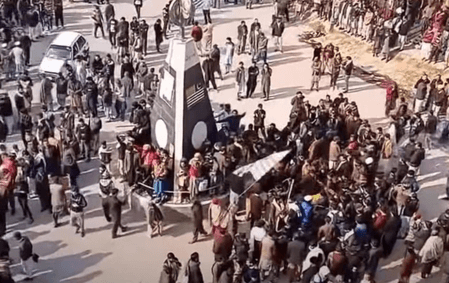
What began as a localized movement over the price of flour and electricity has transformed into
one of the most significant constitutional crises in the history of Pakistan-occupied Jammu and
Kashmir (PoJK). The summer of 2026 has seen the region engulfed in strikes, violent clashes,
and a sweeping government crackdown.
At the heart of the current turmoil is a profound shift in public mobilization: the Joint Awami
Action Committee (JAAC), once focused purely on economic relief, is now challenging the very
foundations of how the region is governed by Islamabad.
The Dispute Over the “Diaspora” Seats
The immediate catalyst for the summer’s escalation is the controversy surrounding 12 reserved
seats in the 53-member Azad Jammu and Kashmir (AJK) Legislative Assembly.
Under the AJK Interim Constitution of 1974, these 12 seats are designated for Kashmiri
refugees who migrated to mainland Pakistan during the 1947 Partition and the 1965 war. Today,
the descendants of these refugees are scattered across provinces like Punjab and Sindh.
The JAAC has made the abolition of these seats its primary demand, arguing that they
represent a critical democratic loophole. Because these seats are voted on by non-residents
living outside the territory’s jurisdiction, protesters argue they provide mainstream Pakistani
political parties with an outsized, unfair advantage in forming the local government in
Muzaffarabad. For the JAAC and its supporters, these seats dilute genuine local representation
and serve as a tool for Islamabad to remote-control regional affairs.
A Legal Roadblock and State Repression
The political dispute hit a legal wall in early June 2026. On June 7, the AJK Supreme Court
delivered a landmark ruling declaring that the 12 refugee seats are constitutionally protected.
The court stated that they cannot be abolished through executive action or public pressure, but
only through a formal constitutional amendment.
This ruling effectively dashed hopes of a negotiated political settlement ahead of the July and
August Assembly elections. The region’s administration, citing public order, had already
proscribed the JAAC on June 5, categorizing it as a banned organization and arresting its core
leadership.
The resulting friction proved deadly. Following the court’s ruling and the ban, widespread
shutter-down strikes and protests paralyzed major cities including Rawalakot, Mirpur, and
Muzaffarabad. The demonstrations descended into violence, with armed clashes between
security forces and protesters leading to multiple fatalities, including a deadly attack on a
hospital in Rawalakot. To curb the mobilization, authorities suspended internet services,
restricted travel, and flooded the region with federal paramilitary personnel.
A Symptom of Structural Discontent
While the 12 reserved seats are the focal point of the current agitation, they are symptomatic of
a much deeper malaise.
The JAAC’s evolution reflects a growing realization among the youth and civil society in PoJK
that their economic miseries—from crippling inflation to infrastructure deficits—are intrinsically
linked to their lack of political autonomy. Despite the territory’s official designation as “Azad”
(Free), residents have long argued that actual administrative and financial power rests firmly
with the federal government in Islamabad.
The 2026 protests suggest that piecemeal economic concessions are no longer sufficient to
pacify the populace. The people of PoJK are increasingly demanding structural reforms, local
accountability, and a legislative assembly that genuinely reflects the will of those living within its
borders. Until these core constitutional and democratic grievances are addressed, the cycle of
unrest and heavy-handed state response is poised to continue.