
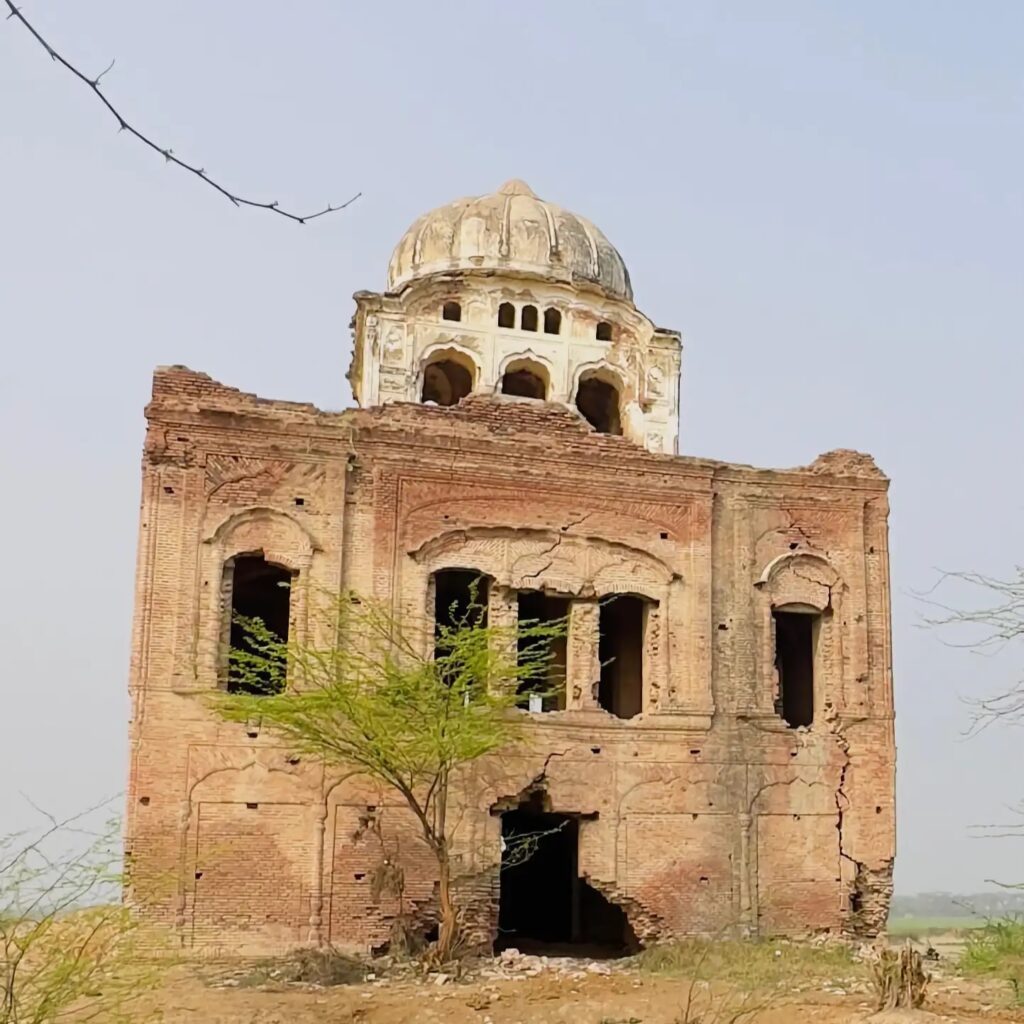
Sikh religious and historical heritage in Pakistan faces a continuing challenge: how to preserve the physical remains of a civilisation whose most significant historical centres now lie across an international border. The concern has resurfaced following an intervention by Giani Kuldeep Singh Gargajj, Acting Jathedar of Sri Akal Takht Sahib, who has urged Maryam Nawaz Sharif, Chief Minister of Pakistan’s Punjab province, to ensure the protection of Sikh heritage sites in Lahore’s Walled City. His appeal, particularly concerning Lal Khooh and Kattari Chandu, highlights the vulnerability of historic places to urban development, inadequate preservation and the gradual disappearance of their original character.
The issue extends beyond the condition of individual buildings. These sites represent the geographical foundations of Sikh history, the sacrifices of the Gurus and the evolution of a religious tradition deeply rooted in the Punjab region. Their disappearance would therefore constitute not merely an architectural loss but a weakening of the historical connection between present-day Sikh communities and their ancestral landscape.
Lahore: A City Central to Sikh History
Lahore occupies a particularly important place in Sikh religious memory. Its historical association with the martyrdom of the fifth Sikh Guru, Sri Guru Arjan Dev Ji, makes the preservation of related locations especially significant. Historical accounts associate Chandu’s haveli with the detention and torture of Guru Arjan Dev Ji in 1606, while a well connected with this history became associated with a gurdwara established at the location.
Lal Khooh and Kattari Chandu, situated in Lahore’s historic inner city, have consequently become the focus of renewed concern. According to reports published in September 2026, Sikh devotees brought concerns about construction-related activity around the site to the attention of Sri Akal Takht Sahib. The reported concerns have prompted a demand for an official inquiry; they should not, however, be treated as proof that heritage destruction has occurred.
In his communication to the Pakistani Punjab Chief Minister, Giani Gargajj clarified that the purpose was not to accuse any government, institution or individual. Instead, he sought an evidence-based assessment of the site’s present condition and historical significance. He also addressed Ramesh Singh Arora, Provincial Minister and President of the Pakistan Sikh Gurdwara Parbandhak Committee (PSGPC).
Partition and the Gradual Loss of Historical Continuity
The vulnerability of Sikh heritage in Pakistan has deep historical roots. The Partition of 1947 displaced millions of people and separated Sikh communities from many of their religious institutions, ancestral homes and places of historical significance. Over subsequent decades, changes in ownership, urban expansion, altered land use and the absence of regular community access complicated the preservation of numerous sites.
In Lahore’s Walled City, the problem is part of a wider heritage-management challenge. Academic research published in 2023 examined how heritage practices in the old city can overlook buildings and residential spaces associated with pre-Partition Hindu and Sikh communities. This raises broader questions about whether the region’s diverse past is being adequately represented in conservation priorities.
This does not establish that every Sikh site has been deliberately neglected or that all heritage losses are politically motivated. Rather, it points to a structural problem: when historical ownership, religious significance and legal protection are not properly documented, surviving landmarks become more vulnerable to redevelopment, deterioration and loss of public recognition.
Beyond Lahore: The Wider Vulnerability of Sikh Monuments
The concern is not confined to Lahore. In September 2025, the Global Sikh Council raised concerns about the deteriorating condition of the historic samadh of Sardar Mahan Singh, father of Maharaja Ranjit Singh, in Gujranwala. Reports indicated that heavy rains had damaged parts of the structure, raising fears of further collapse and prompting calls for urgent restoration.
Such cases illustrate the multiple threats facing historic Sikh structures. Ageing buildings may suffer from water damage, structural instability and inadequate maintenance. Where specialist conservation, regular inspections and dedicated funding are absent, even monuments that have survived for generations can deteriorate rapidly.
At the same time, Pakistan has undertaken conservation initiatives demonstrating that preservation is possible. In January 2026, three monuments at Lahore Fort, including Sikh-era structures, were unveiled following restoration efforts involving the Aga Khan Cultural Service-Pakistan and the Walled City of Lahore Authority. The project formed part of a broader initiative to conserve the fort’s multicultural architectural heritage.
These efforts are important counterexamples to any blanket assertion that Sikh heritage receives no protection in Pakistan. The central question is whether such initiatives can be extended systematically to smaller, less prominent and potentially endangered sites that may not receive comparable public attention.
From Assurances to Enforceable Protection
The intervention by Sri Akal Takht Sahib offers a practical framework for addressing these concerns. Giani Gargajj has called for an immediate inquiry into Lal Khooh and Kattari Chandu, suspension of any construction or alteration activity pending the inquiry, and an assessment by the Walled City of Lahore Authority, archaeology experts, Sikh historians and representatives of the PSGPC. He has also advocated legal protection for the site if its historical significance is established, alongside a comprehensive survey of Sikh heritage locations throughout Lahore’s Walled City.
The effectiveness of these measures will depend on implementation. A credible preservation programme should include an authenticated inventory of sites, photographic and architectural documentation, verification of ownership and legal status, periodic structural inspections and transparent reporting of conservation work. Sites facing immediate risks should receive priority, while Sikh religious institutions and historians should be involved in decisions affecting their historical integrity.
Pakistan’s Punjab government has an opportunity to demonstrate that its stated commitment to restoring historic gurdwaras extends to the wider Sikh historical landscape. Cooperation between government departments, conservation specialists, Sikh organisations and local communities could help protect these places as shared Punjabi heritage rather than treating them as isolated religious landmarks.
The danger confronting Sikh heritage in Pakistan is not simply that old buildings may collapse. It is that, through neglect, unregulated development or the gradual disappearance of historical evidence, the physical links connecting future generations with Sikh history may become irretrievable.
The concerns surrounding Lal Khooh and Kattari Chandu should therefore be resolved through a transparent, time-bound investigation rather than speculation. Equally, the deterioration reported at other Sikh monuments calls for a long-term conservation strategy extending beyond individual controversies.
Preserving this heritage is both a responsibility towards the Sikh community and an investment in Punjab’s shared history. The ultimate test will be whether official assurances translate into documented protection, sustained restoration and the survival of these historical landmarks for generations to come.