
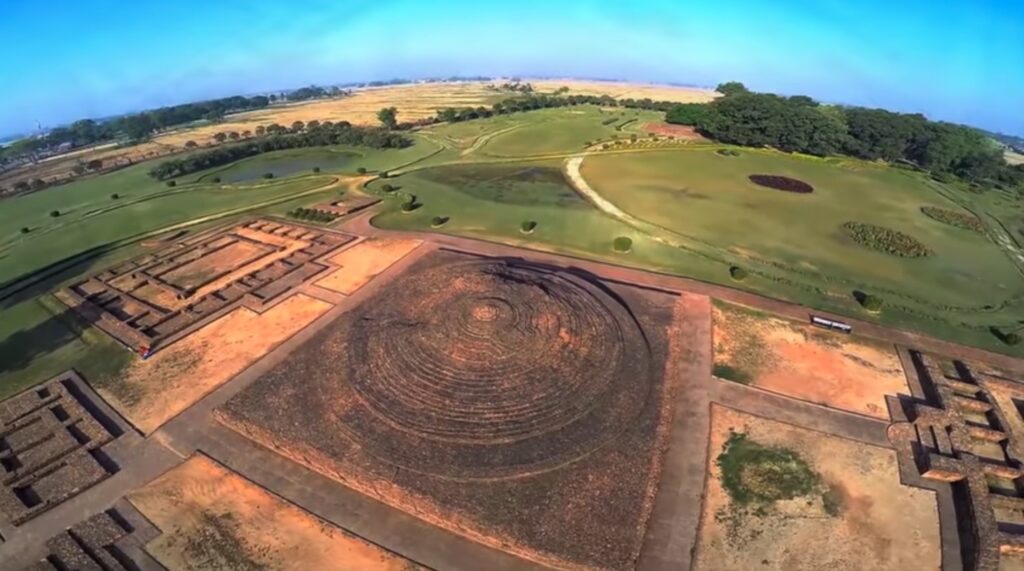
Most stories about cultural repatriation begin with a law, a petition, or a diplomatic note. India’s story about the Piprahwa relics began with an auction house in Hong Kong.
In May 2025, Sotheby’s announced it would sell a portion of the sacred relics of Lord Buddha. The relics had been in British possession since 1898, when a colonial-era landowner named William Claxton Peppé unearthed them at Piprahwa in present-day Uttar Pradesh. What he found was extraordinary: jewels, bone fragments, and inscribed reliquaries buried inside a stone coffer. Archaeological evidence placed the site within ancient Kapilavastu, the hometown of Siddhartha Gautama before he became the Buddha.
The British crown took the primary share of the finds. Peppé retained a portion, which passed through generations of his family. Over a century later, that portion was put up for sale. The timing was poor. The world had changed. So had India’s willingness to watch its heritage disappear into private collections.
The Piprahwa case is not unique in its origin but is unusual in how it ended. Most colonial-era removals of cultural objects end in prolonged legal disputes, museum standoffs or quiet diplomatic failure. India’s intervention in 2025 produced a different result, and understanding how requires looking both at the history of the relics and at the changed global conversation around cultural property.
A Colonial Wound That Never Closed
The Piprahwa relics are not the only artefacts taken from India during the colonial period. The list is long and painful. The Koh-i-Noor, the Sultanganj Buddha, manuscripts, temple sculptures — the inventory of what left India under colonial rule runs into thousands of objects. Most have not come back.
What made the Piprahwa relics different was their nature. These were not decorative objects or royal treasures. They were sacred remains directly connected to one of the most consequential figures in human history. The inscription on the reliquary, translated from ancient Brahmi, identifies the contents as belonging to the Buddha and his kin. For Buddhists across the world, this is not an archaeological claim. It is a statement of the deepest spiritual significance.
The British Museum, the Victoria and Albert Museum, and other institutions have long grappled with the ethics of holding objects taken from colonised peoples. The debate has grown louder in recent decades.
But debate rarely produces results quickly. Greece has sought the Parthenon marbles for generations. Nigeria has fought for its Benin bronzes. Ethiopia has negotiated for its sacred tabots. What produced results in India’s case was something more immediate: a sale that could not be stopped by argument alone but required direct action.
The global moment also helped. The 2023 UNESCO resolution on repatriation, the growing pressure on Western museums to review their colonial-era acquisitions, and the increasing legal sophistication of countries like India all contributed to a climate in which the Sotheby’s auction was politically untenable from the start. But it still required India to act, and act quickly.
The inscription on the reliquary, translated from ancient Brahmi, identifies the contents as belonging to the Buddha and his kin. For Buddhists across the world, this is not an archaeological claim. It is a statement of the deepest spiritual significance.
The Intervention
India’s Ministry of Culture moved fast. It raised objections to the Sotheby’s auction, arguing that the relics could not be treated as private property. The argument rested on both legal and moral grounds. Under international conventions on cultural property, objects with deep civilizational significance cannot simply be traded on the open market. More fundamentally, the Ministry argued, these relics were never legitimately Peppé’s to keep in the first place. They were extracted from Indian soil during a period of colonial occupation, without the consent of the people whose heritage they represented.
The auction was halted. Negotiations followed. By July 30, 2025, the relics had been repatriated to India through a public-private partnership involving the Government of India and the Godrej Industries Group. It was a quiet but historic moment. After 127 years, the Buddha’s relics had come home.
The manner of the repatriation also matters. It was not achieved through litigation or confrontation but through a combination of diplomatic pressure, legal argument and private-sector partnership. The Godrej Industries Group’s involvement signals that cultural repatriation need not be solely a government function. When corporate India aligns itself with civilisational priorities, the results can be swift and significant.
The Exhibition and What It Means
The return of the relics was followed by a grand exhibition. Titled The Light and the Lotus: Relics of the Awakened One,’ it was inaugurated by Prime Minister Narendra Modi on January 3, 2026, at the Qila Raipithora Cultural Complex in New Delhi. For the first time, the repatriated relics were displayed alongside material from the National Museum and the Indian Museum in Kolkata. Over 80 objects were presented, spanning sculpture, manuscripts, reliquaries and jewelled treasures dating to the 6th century BCE.
The venue itself carried meaning. Qila Raipithora is one of the oldest fortified settlements in Delhi, built nearly a thousand years ago. To display these 2,500-year-old relics within this historic complex was to fold different layers of Indian history into a single space. The Prime Minister, who viewed the exhibition before inaugurating it, noted that the departure and return of the relics were both lessons: that colonialism was not only political and economic but also cultural, and that recovery of culture was as meaningful as any other form of national assertion.
The exhibition also prompted a broader question that India is only beginning to answer seriously: how many other objects of comparable significance remain abroad, and what is the plan to bring them home? The Piprahwa relics maybe the most high-profile repatriation in recent memory, but they are unlikely to be the last if the momentum is maintained.
The larger lesson of this episode is not just about one set of relics. It is about what happens when a nation decides that its heritage matters enough to fight for. India has taken that position. The response, in terms of public engagement at the exhibition and popular sentiment, suggests the position is widely shared. The journey from Piprahwa to a British estate to a Hong Kong auction house and back to Indian soil took 127 years. It ended not with a quiet diplomatic arrangement but with hundreds of thousands of people paying their respects. That, perhaps, is the most powerful argument for repatriation of them all.